>
TheSkiathos Guide
Kastro, Skiathos
Kastro Herbert wie Β· CC BY-SA 4.0

Heritage site Β· ΞšΞ¬ΟƒΟ„ΟΞΏ

Kastro

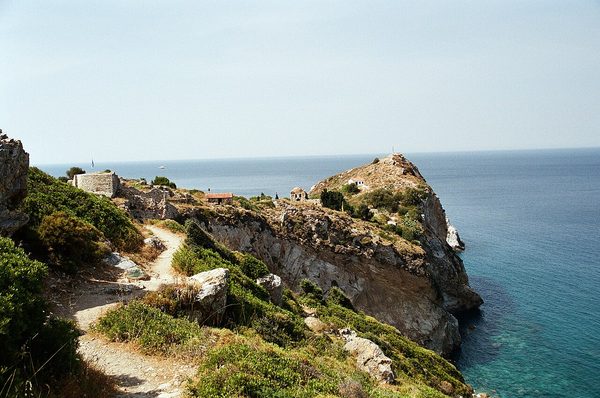
Skiathos's most historically significant site: a ruined fortified town on a cliff, reached only by drawbridge, where the islanders lived for roughly five centuries to escape pirates.

Getting thereCar to the road's end at Panagia Kardasia, t…
Allow2–3 hours from town by car Β· a full day on foot via ST6
CostNo entrance fee mentioned by any source β€” tr…

Why anyone lived on a cliff

Kastro β€” the word simply means "castle" β€” occupies a clifftop headland at the northern tip of the island. Sheer cliffs on three sides, and the only land approach across a gap spanned by a wooden drawbridge that could be pulled up. That was the entire point. Islanders abandoned the low-lying settlement and moved up here because of pirate raids, and they stayed for roughly five centuries.

It was founded in the 14th century and remained the island's capital until the population moved back down to the present-day town around 1829–1830, once Greek independence made the coast safe again. Med

On those dates. Sources conflict. One says founded c.1360; another frames it as capital "from 1540 until 1829"; abandonment is given as both 1829 and 1830. These are probably reconcilable β€” founded in the 14th century, formally the capital later β€” but we could not verify which, so the wording above is deliberately the version defensible against all of them.

The best detail is what happened next. Once piracy ended there was no reason to live on a windswept rock, so the population came down and rebuilt modern Skiathos Town partly with stone carried down from Kastro. The old capital was quarried to build the new one.

What was here, and what survives

At its peak, accounts give 400–500 houses, four parishes, more than twenty small churches, and β€” from the Ottoman period β€” a mosque without a minaret and a Castellan's office. All of those figures are single-source and should be read as approximate.

What you can actually see today:

Sources disagree on whether two, three or more churches survive. A handful do, and the frescoed Christos sto Kastro is the one that matters.

Getting there

By road. Drive north from Skiathos Town. Distance is given as 9km by one source and 12km by another, so we will not print a figure. The tarmac ends and the last stretch is dirt road β€” which matters, because many hire agreements exclude unpaved driving. Park at the church of Panagia Kardasia where the road ends, then walk roughly 30–35 minutes on a stone-paved path. Getting into the site involves steps cut into the rock.

On foot. Trail ST6, "The Roads of Kastro", links Evangelistria Monastery, Agios Charalambos Monastery and Kastro beach as a loop. Roughly 13km with about 650m of ascent, 4–5 hours. It follows the genuine old mule paths that once connected the castle to the town.

By boat. Round-island trips from Skiathos Town stop here, usually with time ashore and a swim. Small boats also run from the old port direct to Kastro beach, the grey-pebble cove below the site, from which you can climb up.

What to know before you go

Worth it for

  • The single most significant historical site on Skiathos
  • A position that explains itself the moment you see it
  • 17th-century frescoes in a church nobody queues for
  • Genuinely empty compared with anything on the south coast

Be honest with yourself

  • These are ruins, not a restored village β€” expecting a photogenic old town will disappoint
  • The final road is unsurfaced; check your hire agreement
  • Almost no shade on the walk in or on the site β€” punishing at midday in July and August
  • Kastro beach below has no sunbeds or parasols, and a single seasonal cafe-bar

Frequently asked questions

Why was Kastro built on a cliff?

To escape pirate raids. The site is a natural fortress with sheer cliffs on three sides and a single land approach across a gap that was spanned by a wooden drawbridge which could be pulled up. Islanders left the low-lying settlement for it and lived there for roughly five centuries.

When was Kastro abandoned?

Around 1829–1830, once Greek independence made the coast safe again. Sources give both years. The population moved back down to the coast and rebuilt modern Skiathos Town partly with stone carried down from the old capital.

How do you get to Kastro on Skiathos?

Three ways. Drive north from town to where the road ends at Panagia Kardasia, then walk 30–35 minutes on a stone-paved path β€” note the final stretch of road is dirt. Hike the ST6 trail from Evangelistria Monastery, roughly 13km and 4–5 hours. Or take a round-island boat trip, most of which stop there.

Is there an entrance fee for Kastro?

No source mentions one and it is an open archaeological site rather than a managed attraction with a ticket office, so it appears to be free. We could not verify this, so do not rely on it.

Is Kastro worth visiting?

If you are interested in history and view, yes β€” it is the most significant site on the island and it is never crowded. If you are expecting a restored, photogenic old town, no. It is open ruins on a rock, and the appeal is atmosphere and position rather than architecture.
More on the island

Other things to see

Keep exploring

All things to do