The Skiathos Guide

Money ยท Entry ยท Health ยท Safety ยท Etiquette

Know before you go

The unglamorous things that ruin a holiday when you get them wrong. Where this page touches entry rules or health cover it tells you to check the official source, because those change faster than any guide can track.

+2 hAhead of the UK
112Emergency, any phone
NoHospital on the island
CashStill needed
First, the clock

Greece is two hours ahead of the UK, not one. Greece runs on EET (UTC+2) in winter and EEST (UTC+3) in summer, while the UK runs GMT and BST. Both countries change their clocks on the same dates, so the gap is a constant two hours all year. People routinely get this wrong by assuming a one-hour difference like France, and it is a good way to miss a ferry or a flight home.

Money

The currency is the euro. Carry cash. Card acceptance has improved but is not universal โ€” smaller tavernas, beach kiosks, water taxis and the bus are cash propositions, and the bus is explicitly cash-only. ATMs are available in Skiathos Town and at the airport; they thin out considerably as you go west along the coast, so draw money before you head out for the day.

Tipping is appreciated rather than obligatory. Rounding up or leaving five to ten per cent at a taverna is normal and generous; there is no expectation of the twenty per cent that North American visitors may be used to.

Is Skiathos expensive? Moderately priced by Greek island standards, and clearly cheaper than Mykonos or Santorini. A sit-down taverna dinner runs roughly โ‚ฌ25โ€“45 a head. The bus is a flat โ‚ฌ2 or โ‚ฌ3 whatever the distance, which keeps getting around genuinely cheap. Car hire is where costs spike โ€” prices roughly double in August.

Entry requirements for UK visitors

Checked August 2026 This section dates faster than anything else here.

Check gov.uk travel advice for Greece before you travel. Entry rules have changed repeatedly and unpredictably through 2025 and 2026, including one reversal specific to Greece. Nothing below replaces the official position on the day you fly.

Your passport must pass two separate tests

Both apply, and they are independent of each other:

  1. It must have been issued less than 10 years before the day you arrive.
  2. It must be valid for at least 3 months after the day you leave the Schengen area.

This is the one that catches people out. Older UK passports could carry up to nine extra months rolled over from a previous passport, so a passport showing a perfectly valid future expiry date can still fail the first test because it was issued more than ten years ago. Travellers have been denied boarding for exactly this. Check the issue date, not just the expiry date.

The 90-day rule

British citizens need no visa for short stays, and may spend up to 90 days in any rolling 180-day period. Two things about that are commonly misunderstood: the allowance is for the whole Schengen area, not per country, so a week in France earlier in the window reduces your Greek allowance; and the 180 days is a rolling backward-looking window rather than a fixed calendar block.

EES โ€” expect biometric registration

The EU Entry/Exit System became fully operational on 10 April 2026, replacing manual passport stamping for non-EU visitors with a digital record of entries and exits, including facial image and fingerprints. It applies to UK travellers, it is free, and it needs no advance application โ€” it happens at the border. Your first crossing takes longest because that is when your biometrics are enrolled.

You may have seen contradictory headlines about Greece specifically. Greece did announce a suspension of EES registration for British visitors around April 2026 to cut airport queues. The European Commission then stated that blanket exemptions for a single nationality are not permitted, and Greece reversed the exemption in late May 2026. Articles still circulating that say British tourists face no biometric checks in Greece appear to be stale. Expect full registration, and allow extra time.

ETIAS is not in force

As of August 2026, ETIAS is not operating and you do not need it. Its launch has been delayed repeatedly; the EU removed its Q4 2026 target from the official ETIAS site in mid-July 2026, and no start date has been confirmed. The stated position is that a date will be announced several months before it goes live. Anyone quoting you a specific launch date is guessing.

Health, and why insurance matters more here

There is no full hospital on Skiathos. The island has a Health Centre in Skiathos Town, reported as operating 24 hours, which handles primary care, minor injuries and emergency stabilisation, plus some private practices. Anything serious means leaving the island โ€” transfer to Volos on the mainland, or Athens for major trauma, by air ambulance or by sea. That single fact is why the insurance advice below is not boilerplate.

GHIC and insurance are not alternatives

The UK Global Health Insurance Card is valid in Greece and free โ€” apply through the official NHS route, and beware copycat sites that charge for the free application. Existing EHICs remain valid until their printed expiry.

It covers medically necessary state treatment on the same basis as a Greek resident, including emergencies and pre-existing conditions. Note "on the same basis": where a Greek resident pays a charge, so do you.

What it does not cover is precisely what an island without a hospital is likely to need: private healthcare of any kind, repatriation to the UK, and air ambulance or medical evacuation. Carry both a GHIC and comprehensive travel insurance, and declare pre-existing conditions or the policy may not pay.

The quad and scooter trap. Many standard travel policies exclude quads, ATVs, scooters and mopeds as hazardous activities. More seriously, if you ride without the licence category legally required for the engine size, insurers routinely void the entire medical claim โ€” not merely the vehicle damage. On an island where quad hire is marketed hard to tourists and the scooter licence position is genuinely unclear, this is the most expensive mistake available to you. See our notes on licences.

Pharmacies and emergencies

Greek pharmacies are marked by a green cross, and pharmacists are well trained โ€” they can advise on minor ailments and dispense things that would need a prescription in the UK. Typical hours are mornings and early evenings on weekdays with limited weekend opening, but a rota guarantees at least one on-duty pharmacy out of hours, posted on every pharmacy door.

Bring prescription medicines in original labelled packaging with a copy of the prescription. Some medicines sold freely in the UK โ€” certain codeine painkillers among them โ€” are controlled in Greece, so check anything you are unsure about with official guidance before you fly.

112 is the emergency number across Europe. It works from any phone in Greece, including a mobile with no SIM or no credit, it is free, operators handle English, and a single call reaches whichever service is needed โ€” police, fire, coastguard or ambulance.

Sea, sun and fire

The sea

Do not assume any beach is lifeguarded. Greek law requires lifeguards on designated organised beaches in season, but we could not verify which Skiathos beaches are staffed, and Troulos is the only one any source specifically described as having them daily. Assume there is nobody watching.

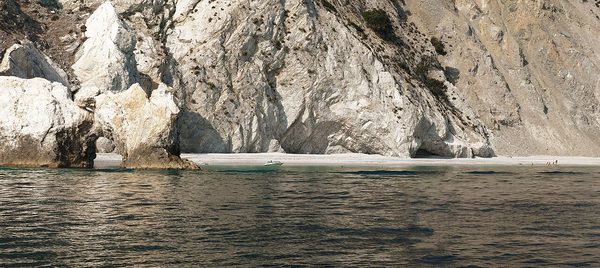
On a strong meltemi day the north coast is where the danger is โ€” currents can pull swimmers offshore faster than they can swim back, and Lalaria in particular gets several-metre waves and a violent undertow from waves reflecting off the cliffs. This is why boat trips there get cancelled, and the cancellation is doing you a favour. Caught in a rip, do not fight it: swim parallel to the shore to get out of it, then angle back in.

Wear water shoes. They prevent the three most common beach injuries here at once. Sea urchins are common on rocky entries; if you are spined, soaking in vinegar helps dissolve the spines and hot water at around 40โ€“45ยฐC for half an hour or more relieves the pain, but get medical help for deep, numerous or joint injuries. Weever fish bury themselves in shallow sand and sting bare feet venomously โ€” the treatment is again very hot water for 30โ€“90 minutes, and most British visitors have never heard of them. For a jellyfish sting, leave the water and rinse with seawater, never fresh water, which bursts the remaining stinging cells and makes it worse; lift off tentacle fragments with tweezers or a card edge rather than rubbing, then use a cold pack. Vinegar is right for urchin spines but is not reliably right for Mediterranean jellyfish, so do not carry that treatment across. Call 112 for breathing difficulty, swelling, faintness, stings to the face or a large area.

Sun and heat

The islands are usually a few degrees cooler than the Greek mainland because of the meltemi, but the sun is no weaker. Stay out of it between roughly midday and 5pm, reapply sunscreen after swimming, and drink consistently. The breeze on a boat trip masks UV exposure, which is why people burn worst on the water. Heatstroke โ€” confusion, hot dry skin, no sweating, collapse โ€” is a 112 emergency, not a lie-down.

Fire

Greece has a serious wildfire season from roughly May to October, and Skiathos is heavily pine-forested, which makes it genuinely fire-prone. The island had a major fire in July 2007 that burned a large area of forest, started near Agia Paraskevi and forced residents and visitors to evacuate towards Troulos. We found no evidence of a significant recent fire on the island, though that is absence of evidence rather than a guarantee.

Lighting any fire or barbecue near forest, or discarding a cigarette, is illegal in fire season and heavily penalised. Greece issues a daily fire risk map in summer, and 112 sends evacuation alerts by SMS in Greek and English โ€” if you get one, act on it immediately rather than waiting for confirmation. Know how to get out of your accommodation.

Earthquakes

Greece is among the most seismically active countries in Europe and Skiathos sits in an active area, though the realistic risk to a visitor is low. Two quakes of magnitude 4.7 and 4.9 struck near the island in late April 2026 with no casualties and no serious building damage โ€” but they did bring small landslides down onto Lalaria beach, which sits directly beneath steep cliffs. Standard advice applies: drop, cover and hold on, then move away from cliffs, old masonry and balconies.

The small stuff that surprises people

The plumbing. Do not flush toilet paper. Greek drainage pipes are narrow and block easily, so paper goes in the bin beside the toilet, which is emptied daily. Visitors find this startling and then stop noticing it. Ignoring it will block your accommodation's system.

Electricity. 230V, standard European two-pin round plugs โ€” type C and F. UK visitors need an adaptor.

Water. Tap water on Skiathos is reported as meeting EU drinking-water standards, but bottled water is what almost everyone drinks, and the reason is taste rather than safety โ€” the mineral content is noticeable.

Phones. Check your roaming position before you travel. Some UK networks reintroduced EU roaming charges after Brexit and some did not, so this depends entirely on your provider. Wifi is widespread in accommodation, cafes and bars, including free wifi at the airport. Mobile signal is good along the populated south coast and unreliable on the remote north-coast beaches.

Meal times. Greeks eat late โ€” 9pm is normal for dinner and 10pm is not unusual. A taverna that is empty at 7.30pm is not a bad taverna; you are early. Many businesses also close for a few hours in the afternoon.

Dress codes. Monasteries and churches are active places of worship and require shoulders and knees covered, men included. Some monasteries lend wraps at the gate; we could not confirm that Evangelistria does, so dress for it rather than count on it.

Language. English is widely spoken throughout Skiathos tourism. A few words of Greek are still worth having: yassas for hello, efharisto for thank you, parakalo for please, signomi for excuse me, ti kanis for how are you. They are received well.

Frequently asked questions

What is the time difference between the UK and Skiathos?

Greece is two hours ahead of the UK, not one. Greece uses EET (UTC+2) in winter and EEST (UTC+3) in summer while the UK uses GMT and BST, and both change clocks on the same dates, so the gap stays at two hours all year.

Do I need cash in Skiathos or can I use a card?

Bring cash. Card acceptance has improved but smaller tavernas, beach kiosks and water taxis often want cash, and the bus is explicitly cash-only. ATMs are plentiful in Skiathos Town and at the airport but thin out as you head west along the coast.

Do UK travellers need ETIAS for Greece?

Not as of August 2026. ETIAS is not yet in operation, its launch has been delayed repeatedly, and the EU removed its Q4 2026 target from the official site in mid-July 2026 without setting a new date. The EU has said it will announce a start date several months in advance. Check gov.uk before you travel.

Will I have my fingerprints taken entering Greece?

Expect to. The EU Entry/Exit System became fully operational on 10 April 2026 and registers facial image and fingerprints for non-EU visitors, including UK travellers. Greece briefly exempted British visitors in April 2026 but reversed that in late May after the European Commission ruled single-nationality exemptions impermissible, so articles saying otherwise are out of date.

What are the UK passport rules for travelling to Greece?

Two separate tests, both of which must pass. The passport must have been issued less than 10 years before your arrival date, and it must be valid for at least 3 months after you leave the Schengen area. Older UK passports could carry extra months rolled over from a previous passport, so check the issue date and not just the expiry โ€” people have been denied boarding on exactly this.

Is there a hospital on Skiathos?

No. There is a Health Centre in Skiathos Town, reported as open 24 hours, which handles primary care, minor injuries and emergency stabilisation, plus some private practices. Serious cases are transferred off the island to Volos or Athens by air ambulance or sea, which is why travel insurance covering evacuation and repatriation matters more here than on the mainland โ€” a GHIC covers none of that.

Can you flush toilet paper in Greece?

No. Greek drainage pipes are narrow and block easily, so paper goes in the bin beside the toilet rather than down it. The bins are emptied daily. Visitors find it surprising and quickly stop noticing.

Are Skiathos beaches lifeguarded?

Assume not. Greek law requires lifeguards on designated organised beaches in season, but we could not verify which Skiathos beaches are actually staffed โ€” Troulos is the only one any source described as having them daily. Watch children constantly and treat the north coast with particular caution in a strong meltemi.

What is the emergency number in Greece?

112. It works from any phone including a mobile with no SIM or no credit, it is free, operators handle English, and one call reaches whichever service is needed โ€” police, fire, coastguard or ambulance. Greece also uses 112 to send wildfire evacuation alerts by SMS in Greek and English.